
Freedom Forever, the second-largest solar installer in the country, filed for bankruptcy in April. If that news made your stomach drop because your panels came from them, or from any of the other installers that have shut their doors lately, you’re not alone. And you’re not out of options.
What’s happening in the DFW solar market right now, what it means if your system got left behind, and why solar is still very much worth it, even with the big federal tax credit gone.
Why so many solar companies are closing their doors
Freedom Forever isn’t an isolated case. It’s the latest, and largest, in a wave that’s been building for a couple of years now. Nearly 6 million U.S. homes have solar panels today, according to the Solar Energy Industries Association, and roughly 100 solar companies nationwide have closed or gone bankrupt since 2023, including big Texas-market names like Freedom Forever, Sunnova, and Solar Mosaic. Industry experts point to the elimination of the federal tax credit and a rise in customers defaulting on their solar loans as the main drivers.
The Center for Responsible Lending has compared some residential solar financing practices to the subprime mortgage lending that helped trigger the 2008 financial crisis, pointing to a pattern of risky loans issued with little regard for whether customers could actually repay them.
Closer to home, a CBS News Texas investigation found that Fort Worth-based TriSmart Solar, which once billed itself as the “#1 Residential Solar Installer in Texas” with more than 17,000 projects, has effectively gone dark. The company hasn’t formally announced a shutdown; in December, its CEO told customers it was “making structured updates” and warned the customer service line would go unstaffed. Three of the company’s six listed executives haven’t worked there since, according to their LinkedIn profiles, and even the app customers use to track their solar production now lists the company as out of business.
On top of the financial troubles, the Texas Attorney General’s office opened investigations into several solar companies this year, including Freedom Forever, Sunrun, Lone Star Solar, and CAM Solar, over complaints about inflated savings promises, confusing contracts, and warranty terms that don’t hold up.
None of that is your fault. But it does leave a real, practical question hanging: what happens to your system, or your unfinished installation, when the company behind it disappears?
What it means to have an “orphaned” solar system
When your installer goes out of business, your system becomes what the industry calls orphaned. That means no one is answering your service calls, your workmanship warranty is likely void, and your monitoring app might quietly stop reporting data one day with no explanation. If your installation is unfinished, the panels might just sit there, waiting on a crew that isn’t coming back.
That’s a genuinely frustrating spot to be in, especially after you already spent real money to go solar. The reality is you signed the contract expecting lower bills and a company that would stand behind its work, and now you’re stuck googling the installer’s name hoping someone, anyone, still picks up the phone.
The good news is that an orphaned system isn’t a dead end. It’s a fixable problem, and it’s one GFE deals with on a regular basis.
What to do if you have an orphaned system:
- Take photos of your current setup, including the inverter, panels, and any visible wiring.
- Gather whatever paperwork you have: the original contract, permit records, warranty documents, and any correspondence with the installer.
- Check whether your system is still producing power and whether your monitoring app is reporting data.
- Reach out to a local installer who can inspect the system and take over the account.
Don’t wait until something breaks to figure out who’s going to fix it. The sooner you get a local company looking at your setup, the easier it is to catch small issues before they become expensive ones.
GFE picks up where other installers left off
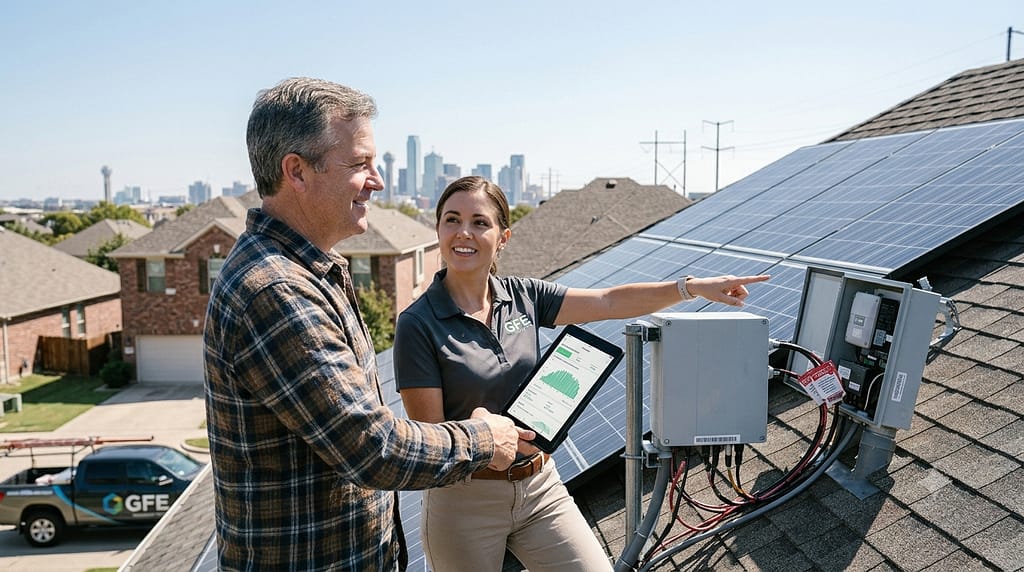
Whether your system was fully installed and now has no one to service it, or the crew never came back to finish the job, GFE steps in. We’ll inspect what’s already on your roof, get your monitoring back online, and either complete the installation or bring your system up to code, whichever it needs.
You don’t have to start from scratch, and you don’t have to live with a half-finished project sitting on your roof as a daily reminder of a bad decision. You just need someone local who’ll actually pick up the phone when you call, and who’ll still be around next year to answer it again.
The tax credit is gone. The 30% savings isn’t.
This is what confuses a lot of homeowners. The federal residential tax credit ended for good on December 31, 2025. People assume that solar savings are gone too. They’re not, they just moved to a different structure.
A prepaid power purchase agreement, or prepaid PPA, lets you capture close to the same 30% savings, just through a different path. Instead of you owning the system outright and claiming a tax credit on your own return, GFE owns the system during the first several years and claims the commercial version of the credit, which is still available through at least 2027. We pass that savings straight to you as a lower upfront cost. There are no monthly payments, no rate escalators down the road, and ownership transfers to you once the initial term is up.
So if you’ve been holding off on solar because you heard the tax credit disappeared, it’s worth a second look. The math still works, it just works differently than it did a year ago.
What to check before you sign with anyone
Given everything happening in this industry, a little caution goes a long way, no matter which company you’re considering. Before you sign with any solar company:
- Ask exactly how they calculate your projected savings, and get the answer in writing, not just a verbal promise.
- Check how long they’ve actually been operating in DFW, not just how big they are nationally.
- Read the warranty terms closely. Know what happens to your workmanship warranty if the installer, not the equipment, is the one that fails.
- Ask what happens to the system if the company changes hands, gets acquired, or closes.
- Get everything in writing before any work starts, especially financing terms and savings estimates.
Frequently asked questions
Is my solar warranty void if my installer goes bankrupt? Your workmanship warranty, the one covering installation quality, is usually tied to the company itself and often becomes void when it closes. Manufacturer warranties on the panels and inverter typically still apply, since those come from the equipment maker, not the installer.
Can I still get 30% off solar in 2026? Yes, through a prepaid PPA structure. The homeowner tax credit is gone, but the commercial credit is still available to companies like GFE, and that savings gets passed on to you upfront.
What if I can’t reach my solar company at all? Start by checking the Texas Secretary of State’s website to see if the business is still registered, then contact a local installer for an inspection. Don’t wait for a response that may never come.
Solar is still worth it in DFW
Bankruptcies don’t change the fact that Texas gets plenty of sun and DFW electricity rates keep climbing year over year. There are companies you can trust to still be around next year, and financing options that still make sense now that the old tax credit is gone.
If you have an orphaned system, your install never got finished, or you just want a second opinion before you sign anything, Good Faith Energy is here for you.
Give us a call today for a free system check or a no-pressure prepaid PPA quote.
Fact checked by Lisa Musser on 7/15/26.